.avif)
You're scaling a SaaS product, pouring budget into paid acquisition, and watching CAC climb quarter after quarter. Meanwhile, the organic channel that could compound over time sits neglected. Enterprise SaaS SEO is the discipline that fixes that.
Here's the thing most teams don't talk about openly: enterprise SaaS sites are sitting on thousands of URLs across feature pages, blog content, help docs, and integration hubs. But fragmented ownership, tech debt, and no clear SEO playbook keep most of it buried. Layer on Google's AI Overviews, rising acquisition costs, and an explosion of AI-generated content... and organic growth in 2026 demands more rigor than it ever has.
The ROI still backs it up. SEO drives a 702% ROI for SaaS, with payback in under seven months. Organic traffic also produces a lower CPL ($147) compared to paid search ($280) on average.
This guide breaks down what slows enterprise SaaS SEO down and how to build a strategy that compounds. Let's get into it.
What Is Enterprise SaaS SEO and Why Does It Matter?
Enterprise SaaS SEO is the practice of optimizing large-scale, complex SaaS websites to improve rankings, drive qualified traffic, and support high-value conversions across long B2B sales cycles. It's a different operating model from standard SEO.
Think about a company selling procurement software to enterprises. You're not trying to rank for "procurement tools" and calling it a day. You're targeting CFO comparison queries, compliance checklist content, and integration-focused searches across multiple personas and funnel stages. Each of those requires a different page type, a different content angle, and a different conversion path.
Enterprise SaaS websites typically share three core characteristics:
- They directly influence revenue and brand performance
- They require cross-functional collaboration from SEO, product, and engineering
- They depend on SEO automation and structured workflows to scale across thousands of pages
Here's how enterprise SEO stands apart from normal SEO:
Why Do Enterprise SaaS Companies Struggle With SEO?
Even strong growth teams hit walls with enterprise SaaS SEO. The problem isn't a lack of knowledge. It's navigating internal complexity, fragmented ownership, and long sales cycles with no instant feedback loop.
Below are the core challenges teams face when trying to scale SEO inside an enterprise SaaS organization.
Technical SEO Gets Stuck in Backlogs
In theory, fixing technical SEO issues should be straightforward. In practice, most enterprise SaaS websites are governed by multiple teams, legacy infrastructure, and dev sprints focused on feature launches rather than metadata or crawl errors.
The result? Key SEO fixes sit in the backlog for weeks. Launch pages miss visibility windows. Revenue-driving content gets buried under pages that no one asked for.
SEO has to be operationalized across content, dev, and web teams with shared scorecards and ownership. Handing it off as one-off tasks doesn't work at this scale.
SEO Rarely Gets a Seat at the Strategy Table
Ask most CMOs if SEO matters, and they'll say yes. But check the quarterly roadmap, and it's rarely there. SEO often lives on the periphery because it doesn't show up in sprint demos, lacks standalone OKRs, and loses out to paid channels with faster attribution.
This is happening just as competition intensifies. The global SaaS industry is expected to grow at a 20% CAGR through 2031, crowding every SERP and making organic visibility harder to earn and more valuable to hold.
Real traction only happens when SEO earns a seat at the strategy table. That means showing how improved organic visibility supports every team, from sales enablement to brand perception. Someone has to champion SEO internally. Not just tactically, but politically.
Proving Impact Is Hard When Conversion Cycles Are Long
Enterprise SaaS deals don't close in a single session. Users bounce between blog posts, integration pages, review sites, and sales calls before signing a contract. Yet SEO rarely gets full credit for the pipeline it influences.
Most SEO dashboards stop at traffic. But traffic alone doesn't convince leadership. You need to tie organic performance to down-funnel metrics: trial signups, demo requests, and influenced pipeline. That requires tight alignment with RevOps and the right attribution model.
A Reddit thread on r/SaaSMarketing captures this tension well:
Enterprise Saas SEO Reality Check: Leads Don't Close Deals
High-performing teams reframe what "wins" look like: improved crawl health, higher non-brand visibility, and better share of voice in competitive SERPs. This reframing is essential when the sales cycle spans months and involves multiple touchpoints.
How Should You Build an Enterprise SaaS SEO Strategy That Delivers Results?
Before diving into specific tactics, it's worth understanding that enterprise SaaS SEO requires a fundamentally different approach from standard SaaS SEO. Here are the strategies that drive measurable results.
1. Build Keyword Strategy That Maps to Buyer Intent and Pipeline
Create Buyer Personas First
In enterprise SaaS, your buyers aren't a single persona. You're targeting multiple stakeholders, each with distinct roles, goals, objections, and search behaviors.
A CRM platform might target sales managers with automation keywords while focusing on security and integrations for IT admins. If your keyword strategy doesn't reflect that, you're optimizing for the wrong people.
Not sure how detailed your personas should be? TripleDart's Buyer Persona guide has frameworks you can hand off to your content or SEO team.
Research Keywords by Funnel Stage
Once you know your personas, map their search intent to funnel stages:
Many SaaS teams underuse niche, low-volume, high-intent searches like "CRM with GDPR compliance" or "CRM API for healthcare SaaS." These queries often convert better because they reflect real buying signals from decision-makers with specific needs.
Use tools like Semrush or Ahrefs to validate search volume and difficulty. Layer in competitor research to spot keyword gaps you can own.
Map Keywords to the Right Page Types
Assign each keyword set to the right page type based on intent and persona:
Revisit and update your keyword mapping quarterly to stay aligned with evolving search trends and user behavior.
2. Operationalize On-Page SEO Across the Entire Site
On-page SEO at enterprise scale isn't a tactical checklist. It's a governance challenge. Here's what that looks like in practice:
- Template governance and automation: Most enterprise SaaS sites use modular design systems or headless CMS setups. Your SEO strategy needs strict controls and automated rules to enforce consistent use of title tags, H1s, meta descriptions, and schema markup at scale. An incorrectly coded H1 in a global template can cascade across hundreds of pages.
- Preventing keyword cannibalization: With multiple feature or solution pages targeting similar keywords, enterprise sites are prone to cannibalization. Assign keyword ownership, audit overlaps regularly, and monitor performance through GA4 and Search Console.
- Strengthening internal linking logic: On large SaaS sites, linking often breaks due to template errors, legacy content, or siloed teams. Implement scalable internal linking strategies like dynamic link widgets and crawl-path audits.
- Optimizing dynamic content: SaaS sites frequently include dashboards, calculators, or user-customizable content. Ensure they are SEO-friendly using server-side rendering or prerendering where possible.
A broken global template or CMS update can quietly derail hundreds of pages and impact your pipeline before anyone notices. On-page SEO governance needs clear ownership, template-level QA, and automation baked into publishing workflows.
3. Strengthen Technical SEO to Safeguard Rankings
When your site spans thousands of URLs, subdirectories, and languages, technical SEO becomes the foundation everything else rests on. One wrong update can impact hundreds of URLs overnight.
Improve Crawlability and User Experience
Search engines can't rank what they can't crawl. At scale, you need to manage crawl budgets wisely:
- Prioritize which pages search engines should visit
- Prevent URL bloat and parameter duplication
- Monitor crawler behavior with log file analysis
- Use server-side or dynamic rendering for JavaScript-heavy content
- Automate sitemap generation to keep indexation up to date
Build a Mobile-Responsive Website
Mobile traffic makes up over 62% of global website traffic. But most enterprise sites still treat mobile SEO like a checkbox. Watch for template lag, version mismatch, and broken hreflang tags, especially for multilingual setups.
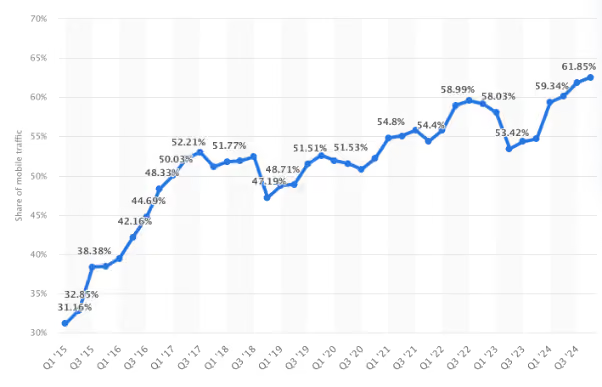
Global mobile traffic share grew from 31% in 2015 to 62% in 2024
Use Structured Data and Schema Markups
Schema helps search engines understand your content and boosts visibility with rich results. At enterprise scale, automate schema deployment through CMS templates and audit regularly to keep markup accurate.
Improve Page Speed
In enterprise SaaS, page speed isn't a ranking signal you can deprioritize. It's a pipeline issue. Even a one-second delay can drop conversions by up to 20%.
At scale, improving speed means baking performance into your entire development process:
- Set performance budgets that dev and design teams follow
- Run automated Lighthouse audits using tools like WebPageTest, Calibre, or SpeedCurve
- Integrate page speed checks into your CI/CD pipeline
- Include speed and Core Web Vitals in pre-launch QA
4. Build a Content Marketing Strategy That Drives Pipeline
Content is what drives enterprise SaaS SEO more than anything else. A well-built SaaS content strategy can deliver over 448% ROI. But "more content" isn't the answer. Better content, mapped to buyer intent, is.
Develop Brand Content Guidelines
Your content should reflect your brand across every word, image, and layout. A comprehensive brand content system should include your core value proposition, tone and voice by funnel stage, CTA formats, and messaging pillars.
Use governance tools like GatherContent or Frontify to manage workflows and ensure consistency across teams, regions, and agencies.
Build a Blog and Resources Page With Intent
Don't build a blog for traffic. Build it to move buyers through the funnel:
- Match content formats to funnel stages (TOFU thought leadership, MOFU integration guides, BOFU comparisons)
- Go beyond keywords; use insights from sales calls, CRM data, and intent tools
- Test CTA types and placements across assets
- Use attribution tools like GA4, HubSpot, or Dreamdata to track pipeline influence
With 87% of marketers now using AI to help create content, the bar for quality keeps rising. AI content is 4.7x cheaper than human-written content, which means everyone can publish more. The differentiator is strategic depth and original insight.
Build a Pillar/Cluster Content Strategy
Topic clusters bring structure to your content and make it easier for users to navigate. Start with a broad pillar page, like "enterprise CRM," then build cluster content for subtopics like "CRM for sales teams" or "CRM vs. ERP."
Assign ownership of pillar content to product marketing or SEO leads. Use CMS logic to handle internal linking automatically. Monitor keyword overlap and resolve cannibalization early using GSC, Clearscope, or Ahrefs.
Create Content Assets for Backlinks
Good content earns clicks. Great content earns links. At the enterprise level, focus on creating:
- Original research with proprietary data or expert insights
- How-to guides that solve specific, high-stakes problems
- Infographics and visual explainers for sales enablement and co-marketing
- Quote-worthy stats and frameworks that analysts and writers can reference
Align SEO, content, and PR calendars to time outreach. Track which assets drive the highest DA lift, referral traffic, or brand mentions.
Refresh Content Quarterly
Enterprise SaaS websites scale fast. But if you only add and never clean up, content bloat and outdated pages will drag performance down. Use tools like Animalz Revive or Clearscope to flag underperforming pages. Merge similar pieces, update old posts with new data, and remove pages that no longer support your goals.
5. Create a Strong Backlink Profile
Content brings people to your site, but links build your authority. Without a strong link profile, your SaaS SEO strategy will plateau.
- Guest posting: Pitch original, insight-led content to publications your ICP reads. Prioritize value and relevance over link quantity.
- Reverse engineer competitors: Use tools like Ahrefs, Semrush, or Moz to analyze competitors' backlink profiles. Find the sites linking to them and why, then create content that outperforms theirs.
- Create linkable visual assets: ROI frameworks, strategy maps, product comparison matrices, and data storytelling visuals. Use design platforms like Canva, Visme, or Napkin AI to generate layouts.
- Broken link building: Scan niche blogs and resource pages using Screaming Frog. Identify broken outbound links, then reach out to the site owner and offer your page as a replacement.
6. Align Teams, Tools, and Reporting to Drive Organic Growth
You can't scale enterprise SaaS SEO without the right people and the right tools working together.
Structure Your SEO Team
Structure your team around three functional layers:
- Strategic leadership: Connect SEO goals to business KPIs, prioritize by pipeline impact, and advocate for resourcing at the executive level.
- Execution teams: Specialists across on-page SEO, technical SEO, and off-page SEO. Embed SEO ops within existing content, dev, and web ops workflows.
- Data and reporting owners: Own dashboards for keyword growth, traffic, and conversions. Tie content and technical changes to pipeline outcomes.
This thread on r/SaaS captures the organizational challenge well:
Doing SEO for Enterprise Saas? Nail Exec Buy-in or Prepare for a Long Road
Outsource to a SaaS Enterprise SEO Agency
The right SEO agency can expand your capabilities, reduce execution drag, and bring deep expertise to complex programs like large-scale site migrations, internationalization, or architecture redesigns.
They also offer an outside perspective to challenge assumptions, identify growth levers, and spot emerging enterprise SEO trends before your internal team can.
Get the Best Enterprise SaaS SEO Tools
Scaling SEO for a site with 10,000+ pages demands robust platforms. Top-tier tools like BrightEdge, Semrush, and seoClarity offer comprehensive site audits, advanced keyword research, workflow management, and attribution dashboards.
Align Reporting With Revenue Goals
Tracking rankings or clicks isn't enough. Executives want to see SEO's influence on pipeline and ARR. Your reporting framework should:
- Map SEO initiatives to KPIs like opportunity creation, deal velocity, and pipeline coverage
- Segment insights by audience: granular for SEO teams, high-level for CMOs
- Include strategic reviews (quarterly), performance snapshots (monthly), and real-time alerts for urgent issues
Use centralized dashboards to connect GA4, GSC, Salesforce, HubSpot, and your SEO tools. This gives your team and leadership a single source of truth.
7. Prepare for AI Search and Generative Engine Optimization
This is the strategy most enterprise SaaS companies are missing in 2026. With AI Overviews, ChatGPT, Perplexity, and Claude reshaping how buyers discover software, your SEO strategy needs to account for generative engine optimization.
Here's what forward-thinking enterprise teams are doing:
- Structuring content for AI citation: Clear definitions, numbered steps, comparison tables, and original data points make your content more likely to be cited by LLMs.
- Building third-party brand mentions: AI models pull from a wide range of sources. Getting mentioned on review sites, industry publications, and community forums (like Reddit) increases your brand's presence in AI-generated answers.
- Monitoring AI visibility: Track how often your brand appears in AI search results alongside traditional SERP tracking. Tools for answer engine optimization are maturing fast.
What KPIs Should You Track for Enterprise SaaS SEO Success?
Once you start tracking SEO performance, here are the KPIs that matter most:
What Common Enterprise SaaS SEO Mistakes Should You Avoid?
Based on patterns we see across hundreds of accounts, these are the mistakes that hurt enterprise SaaS SEO performance the most:
- Publishing the wrong content: Creating content for traffic volume instead of buyer intent. A blog post that ranks for a high-volume informational query but attracts zero ICP visitors is a waste of resources.
- Letting pages compete for keywords: Without careful keyword mapping and canonical tag strategies, feature pages and blog posts end up cannibalizing each other.
- Over-gating educational content: Putting TOFU content behind forms reduces organic visibility and limits the content's ability to build topical authority.
- Ignoring mobile parity at scale: Inconsistent titles, content, or structured data across device versions quietly erodes rankings.
- Treating SEO as a one-time project: Enterprise SEO is an ongoing operational discipline. Without quarterly refresh roadmaps and continuous technical audits, performance degrades over time.
How Can TripleDart Help Scale Your Enterprise SaaS SEO?
Most enterprise SaaS SEO efforts don't fail because the strategy is flawed. They fail because they're fragmented: content lives in silos, SEO becomes a checkbox, reporting focuses on traffic rather than business outcomes, and no one can clearly attribute what's driving pipeline.
We've seen these challenges across our 250+ B2B SaaS accounts, and we've built systems to fix them.
As an AI-native SaaS marketing agency, TripleDart builds scalable systems that make enterprise SEO work where it counts:
- Strategy rooted in business goals, not search intent alone
- Execution frameworks that break down silos between SEO, content, product, and analytics teams
- Reporting that connects search visibility directly to revenue, pipeline, and CAC
- GEO and AI search optimization built into every engagement
This is about building a consistent growth engine that lowers customer acquisition costs and supports long, complex sales cycles.
If that's what you're working toward, we should talk.
FAQs
Is Enterprise SaaS SEO Necessary?
Yes. Without it, your SaaS business risks getting overlooked in an increasingly competitive market. Enterprise SaaS SEO improves search rankings, drives organic traffic, and establishes authority across the buyer journey, all while reducing dependence on paid channels.
How Does Enterprise SaaS SEO Differ From Regular SEO?
Enterprise SaaS SEO operates at a different scale entirely. It involves managing thousands of URLs, coordinating across multiple teams and regions, handling complex CMS architectures, and aligning SEO with long B2B sales cycles. Regular SEO typically involves a single site managed by a small team.
What Are the Most Common Enterprise SEO Mistakes?
The biggest mistakes include neglecting technical SEO, ignoring mobile parity at scale, publishing content without buyer intent alignment, allowing keyword cannibalization across feature pages, and failing to track SEO's influence on pipeline rather than traffic alone.
How Long Does It Take to See Results From Enterprise SaaS SEO?
Enterprise SEO operates on a 6-12 month feedback loop. You may see early indicators like improved crawl health and non-brand visibility within two to three months, but meaningful pipeline impact typically materializes in six months or more.
What Makes Enterprise SaaS SEO So Difficult?
The complexity comes from large-scale websites, diverse product offerings, continuous platform updates, cross-functional dependencies, and the need to prove ROI across long conversion cycles. It demands specialized expertise in both technical execution and organizational alignment.
How Does TripleDart Help With Enterprise SaaS SEO?
As an AI-native SaaS marketing agency, TripleDart builds scalable SEO systems for enterprise SaaS companies, covering everything from technical SEO audits and content strategy to AI search optimization and revenue-aligned reporting. We work as an embedded partner across SEO, content, product, and analytics teams to drive measurable pipeline growth. Book a call to see how we can help.