Will AI Replace SEO? How AI Is Reshaping Search Optimization in 2026

Key Takeaways
AI will not replace SEO. But it has already rewritten the rules for how search works, what content gets found, and which brands stay visible.
Search engines now answer user questions directly on result pages. AI-generated summaries, zero-click results, and personalized feeds are changing how people search and how brands get discovered. According to GoodFirms, 58.5% of searches are zero-click - users get what they need without ever visiting a website.
Traditional SEO tactics like keyword-heavy blogs and high-volume publishing are losing ground. Click-through rates are dropping, user behavior is evolving, and marketers keep asking: will AI replace SEO?
A better question: how will AI affect SEO, and how can you adapt before your competitors do?
This article covers how AI is reshaping search behavior, why traditional SEO playbooks are breaking, and what B2B SaaS teams need to do right now to stay ahead. Let's get into it.
How Are AI and SEO Connected Today?
AI has been part of SEO for years. What changed is how visibly it now impacts rankings, visibility, and user behavior - from Google's core algorithms to the tools marketers use daily.
Google's Search Algorithms
When RankBrain rolled out, Google started using machine learning to interpret search intent, not keywords. Marketers had to focus on relevance, not repetition.
Then came BERT, which allowed Google to understand language more like a human - factoring in context, phrasing, and nuance. Writing naturally became an SEO advantage, not just good UX.
Now, with MUM, AI understands meaning across languages, formats, and images. Its goal is to deliver richer, more complete answers. Content can no longer be optimized only for bots. It has to inform, connect, and serve users genuinely.
Content Optimization
AI has changed how content is created, optimized, and discovered. Tools like SurferSEO and Clearscope use AI to analyze search intent, competitor content, and on-page SEO factors in real time.
Marketers can now identify the right keywords, optimize structure and readability, and align content with what users and search engines expect - all faster than before.
Personalization and User Experience
Google's algorithms now rely on behavioral signals to understand what content users find valuable. Metrics like click-through rate, time on page, and bounce rate help train AI models to recognize engagement patterns.
If users click and immediately leave, that sends a negative signal. If they stay, scroll, or click through to other pages, Google's models adjust rankings to reward that engagement.
AI-powered personalization takes this further. Google uses user behavior, preferences, location, and search history data to tailor results in real time. Two people searching the same query might get different results because the AI knows what each is likely looking for.
Predictive Analysis
One of the most powerful things AI brings to SEO is speed - not in processing data, but in closing the gap between emerging trends and content creation.
Traditionally, SEO planning meant waiting for search volume data before targeting a keyword. But by the time the data confirmed demand, the first-mover advantage was already gone.
With AI-powered tools, content teams can spot trend signals earlier, often before they show up in traditional keyword research:
- Exploding Topics scans online behavior and content growth patterns to detect emerging topics before they go mainstream
- SparkToro reveals where your audience's attention is moving across conversations, sources, and influencers they trust
- BuzzSumo tracks content formats and headlines gaining real-time traction across platforms
These tools let marketers monitor real-time conversations, identify rising questions or pain points, and move fast - leading to better timing and a greater chance of earning visibility before the SERPs get saturated.
Why Won't AI Fully Replace SEO Professionals?
If the future of SEO belonged to automation alone, we would already be obsolete. Instead, AI is changing how we do SEO, but it has never been an SEO vs. AI issue.
This is a point the SEO community keeps coming back to. As one Reddit user put it:
Will AI replace SEO jobs in future?byu/Seo_Developer inSEO
The consensus is clear: AI can automate tasks, but it cannot create strategy.
AI Enhances SEO Processes, Not Replace Them
AI has sped up nearly every part of the SEO workflow:
- Keyword Research used to require hours of manual digging. Now, tools like ChatGPT suggest keywords in seconds based on intent and trend.
- Content Optimization was once about gut instinct. AI SEO tools like Clearscope help tailor content to match search intent and structure it for readability and performance.
- Content Generation for ideas, outlines, or even first drafts is quicker and frees up time for strategy and creativity.
But while AI helps you move faster, it cannot tell you what to prioritize, why your message matters, or how to connect with your ideal customer profile. It won't replace deep understanding of your audience's pain points, strategic decisions about positioning, or the nuance of your brand voice.
And if overused, AI-generated content starts to feel generic, robotic, or indistinguishable from everyone else's. You've probably read a few of those this week.
The Importance of Human Insight
At the heart of every effective SEO strategy is human understanding. Every brand has a unique voice, a specific audience, and a strategic positioning that cannot be templated. No two businesses solve the same problem in the same way.
AI can analyze patterns, suggest keywords, optimize structures, and predict behaviors. But it cannot:
- Understand the unspoken anxieties behind a buyer's search query
- Recognize cultural nuance, humor, urgency, or subtle tone differences
- Tell the story that builds trust beyond the first click
Leaving all SEO to AI would result in generic content, missed opportunities, and a disconnect with your audience. This is exactly why "will AI replace SEO experts" remains a question with a firm "no" - the strategic layer is irreplaceable.
How Is SEO Adapting to AI Changes?
Every time Google makes a major update or new technology enters the scene, the same headline surfaces: "SEO is dead." But if that were true, brands wouldn't still be generating millions in pipeline from organic search.
What's actually happening? SEO is evolving:
- From writing for rankings to writing for real answers that users want
- From high-volume blogging to targeted, AEO-friendly content
- From waiting on search trends to using AI to predict them
What Are the Ethical and Strategic Risks of AI in SEO?
AI makes it easier than ever to scale content, but with that power comes responsibility and risk.
Without human oversight, AI can tempt teams into shortcuts that undermine long-term trust:
- Publishing unreviewed AI-generated content that is factually shaky or tone-deaf
- Inflating topical authority by flooding a site with low-quality, surface-level pages
- Cloaking content - presenting one version to users and another to search engines with AI-generated variations
These tactics might deliver a short-term bump. But they reduce credibility, break user trust, and risk penalties from search engines.
The smartest teams use AI as a tool, then rely on human judgment to ensure accuracy, protect brand voice, and prioritize content that is genuinely helpful - not just optimized.
How Could AI Disrupt Traditional SEO Practices?
AI shows you what ranks. But it also reveals what doesn't deserve to. The shortcuts, the content farms, the "just hit publish" mindset - SEO practices that once worked are now crumbling.
If you don't structure content for quick answers, you're not even in the game. According to GoodFirms, 83% of AI queries end on the SERP - users rarely click through from AI-generated responses.
Start optimizing for AEO now:
- Lead with the answer
- Use bullet points, subheadings, and FAQs
- Target long-tail, question-based queries
- Add schema markup to support visibility
In a zero-click world, the brand that answers first wins.
What Role Do ChatGPT and Other AI Tools Play in SEO Today?
AI tools like ChatGPT, Claude, and Jasper are speeding things up, but they're not a substitute for human insight. Here's how these AI tools make SEO faster and smarter:
1. Generate Content Ideas
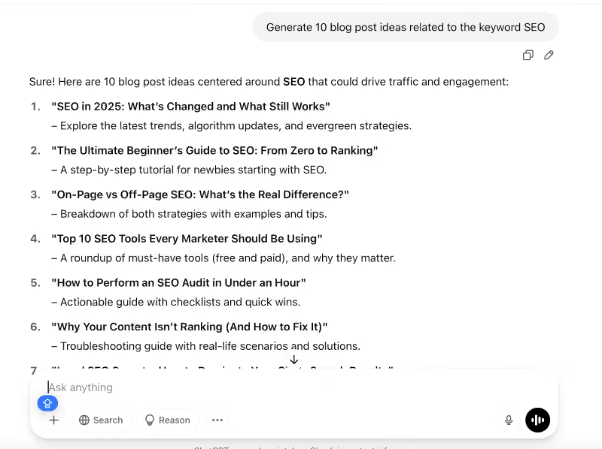
Tools like ChatGPT, Jasper, and Copy.ai can help generate fresh content angles, blog topic ideas, and content gaps based on keyword prompts and user intent trends. Instead of starting from a blank page, teams can move straight to refinement and strategy.
2. Create Drafts and Outlines Fast
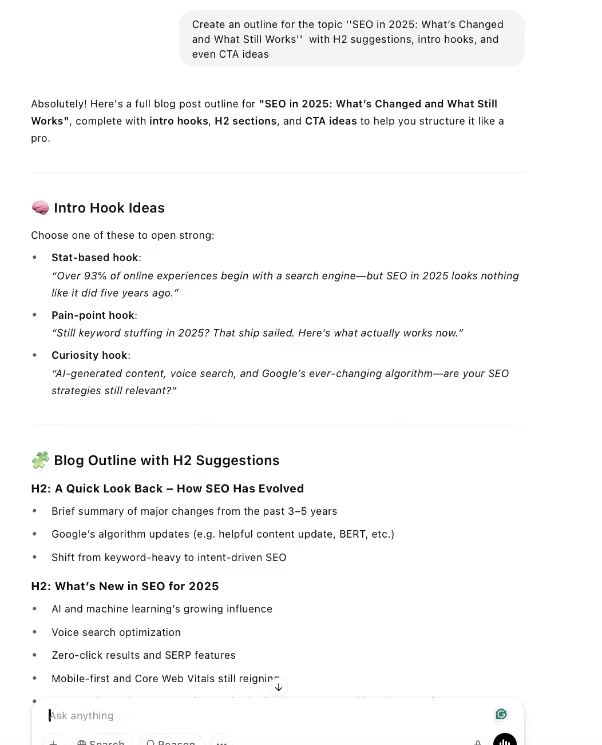
AI tools like ChatGPT and Claude can build outlines, hooks, CTAs, and rough drafts in seconds. But these drafts still need human editing to reflect brand tone and SEO best practices.
3. Help with On-Page SEO
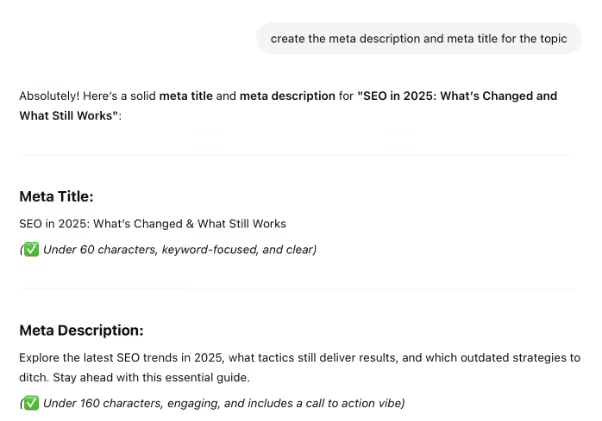
ChatGPT helps with writing meta titles and descriptions, optimizing headers, and identifying places to include relevant keywords. It's also great for improving readability.
You still need SEO tools for other on-page essentials like internal linking strategy, schema markup, image optimization, and mobile UX.
4. Topic Clustering and Entity Mapping
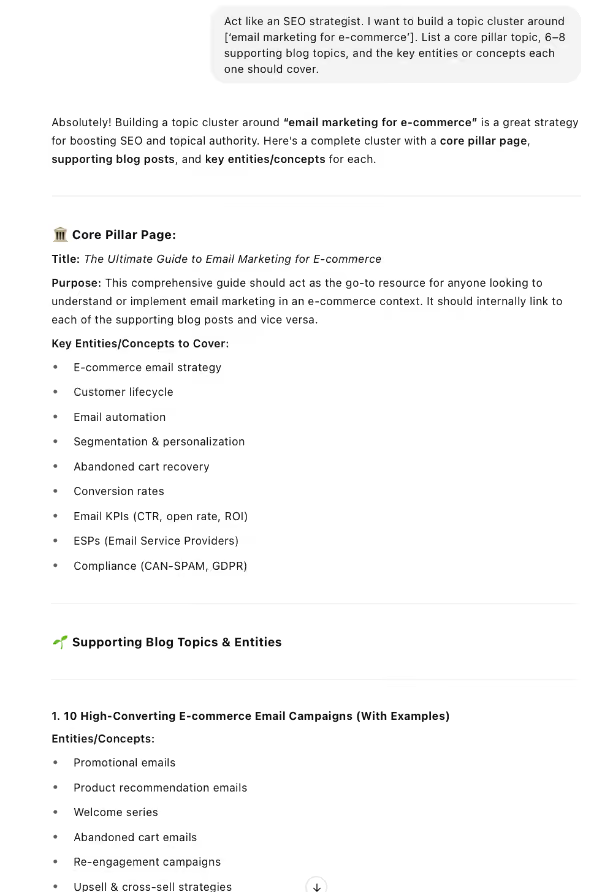
Drop in a primary keyword and ask ChatGPT to build out related subtopics, supporting blog ideas, and the entities you should cover. It helps you plan content that supports a cluster strategy.
Tools like Clearscope and Frase further map out topic clusters around core themes, ensuring semantic depth and topical authority.
5. Generate Schema Markup
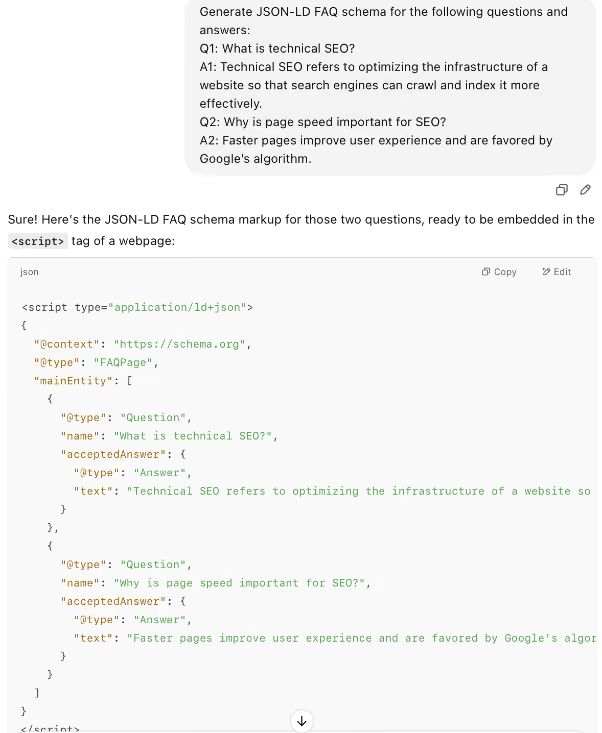
Adding structured data used to mean copying examples or bugging a developer. Now you can ask ChatGPT to generate clean JSON-LD for FAQ, HowTo, Article, and Product pages. Give it the content, and it formats it for you.
6. Programmatic SEO at Scale
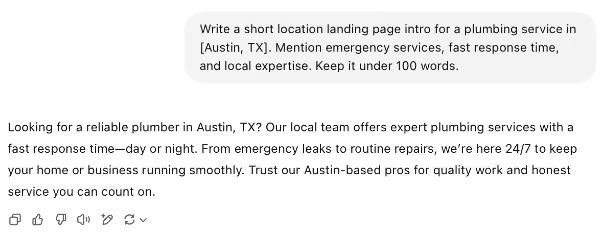
You can feed ChatGPT a template and a dataset (e.g., location, product type, features), and it generates consistent but unique page copy. This is how programmatic SEO scales long-tail keyword targeting.
You still need to manage input data and quality review manually, though.
7. Generate Keyword Ideas
ChatGPT can brainstorm keyword variations, long-tail phrases, and related questions your audience might be searching for. This is especially useful in the early stages of content planning.
But it doesn't pull real-time data. You need tools like Ahrefs or SEMrush to get search volume, competition scores, and trend analysis.
8. Content Scoring and Optimization
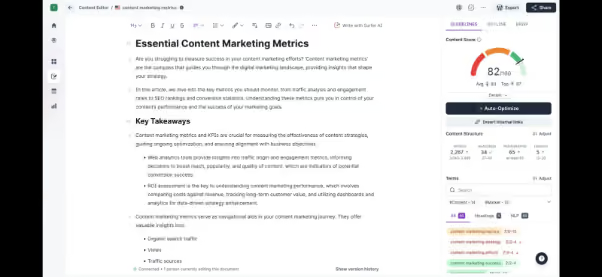
Tools like Surfer SEO, Clearscope, and MarketMuse give you live feedback as you write, showing how well your content stacks up against top-ranking pages. They scan competitors, find related terms, and flag what's missing.
Will AI Search Replace SEO as We Know It? The Rise of AEO
If your traffic is dipping, it may not be a content quality problem - it could be a format problem. AI is changing how people search and how answers are delivered.
With the rise of AI Overviews, voice assistants, and zero-click results, users often get what they need without clicking through. If your content isn't optimized for these AI-driven formats, it's already being skipped.
That's where Answer Engine Optimization (AEO) comes in. Traditional SEO aims to rank. AEO aims to answer.
What Is AEO and How Does It Differ from Traditional SEO?
AEO is about structuring content so AI tools can pull it directly into:
- Featured snippets
- People Also Ask boxes
- Voice assistant replies
- AI summaries and knowledge panels
The goal? Be the answer, not just an option.
Here's how the same topic might be written two ways:
Traditional SEO Copy:
Many people wonder how often they should water their succulents. It depends on a few factors, such as the season, indoor vs. outdoor placement, and soil type. Generally, succulents need to be watered less frequently than other houseplants. Overwatering is a common mistake that can cause root rot...
AEO-Optimized Copy:
How often should you water succulents?
- Once every 2-3 weeks during spring and summer
- Monthly in fall and winter
- Always let the soil dry completely between waterings
Avoid overwatering. Root rot is the #1 killer of succulents.
See the difference? AEO copy leads with the answer, formats it clearly, and uses bullet points for fast scanning and easy AI extraction.
Yet only 14% of businesses track AI visibility, which means most brands are flying blind in this new search environment.
How Will AI Affect SEO Careers and Workflows?
A common concern among SEO writers and specialists is whether AI will replace SEO professionals entirely. The Reddit community has strong opinions on this:
byu/Seo_Developer indigiknowledge
The pattern is consistent: AI is replacing low-skill SEO tasks, not SEO experts. People who only did basic keyword stuffing or generic content are getting displaced. But professionals who bring strategic thinking, audience understanding, and creative judgment? More valuable than ever.
According to Search Logistics, 70% of businesses report higher ROI when they focus on integrating AI into their SEO workflows rather than treating it as a replacement. The best ways to adapt SEO careers against AI advancements include:
- Learning to use AI tools as force multipliers for research and drafting
- Developing deeper expertise in content strategy and audience psychology
- Building skills in AEO, GEO, and AI visibility tracking
- Focusing on E-E-A-T signals that AI cannot fabricate
The impact of AI on future jobs for SEO writers is not elimination - it's elevation. The bar is higher, and the work is more strategic.
What Are the Predictions for AI Taking Over SEO by 2030?
The predictions for AI taking over SEO by 2030 aren't about replacement - they're about convergence. Here's what we see happening:
AI search engines are changing SEO practices in ways that demand new skills. About 35% of Gen Z in the U.S. already use AI LLMs to search for information, which means the next generation of B2B decision-makers will expect AI-first experiences.
The pros and cons of AI replacing traditional SEO workflows break down like this:
What AI does well:
- Automates repetitive tasks like keyword clustering and meta tag generation
- Speeds up content ideation and first-draft creation
- Enables programmatic SEO at scale
- Provides real-time content scoring and optimization feedback
What AI still cannot do:
- Build genuine brand authority and trust
- Understand the emotional context behind a B2B purchase decision
- Create original thought leadership based on proprietary data
- Navigate the nuance of competitive positioning
The brands that will win aren't choosing between AI and human expertise. They're combining both - using AI to scale insight, not just output.
What Are the Key Takeaways for SEO Teams in 2026?
As AI continues to evolve, the future of SEO with AI is clear. Rather than replacing SEO, AI is pushing marketers to adapt faster, think smarter, and work more strategically.
- AI is changing how we approach SEO. It automates tasks like keyword research, content optimization, and programmatic SEO. But even with these efficiencies, human oversight remains critical to ensure quality, relevance, and brand alignment.
- Traditional SEO is evolving, not disappearing. Tools like ChatGPT are becoming standard for content ideation and optimization. Real differentiation, though, depends on human-driven strategy, creativity, and a deep understanding of audience needs.
- New trends like AEO and GEO are reshaping content structure. They prioritize direct, concise answers for AI-driven search results while also optimizing for AI-generated experiences.
- Personalization and predictive search are making generic strategies obsolete. Success now depends on understanding user intent at a deeper level.
- SEO professionals must stay agile. As algorithms evolve rapidly with AI, flexibility and continuous learning are non-negotiable.
- Partnering with an AI-native SaaS marketing agency like TripleDart ensures you're using technology to scale insight, not just output. As an AI SEO agency, we help B2B SaaS brands build organic strategies that work across traditional search, AI Overviews, and LLM-powered answer engines - so your content drives pipeline, not just pageviews.
The real battle isn't SEO vs. AI. It's lazy strategy vs. strategic creativity.
Frequently Asked Questions
Will using AI tools get my website penalized by Google?
Not necessarily. Google doesn't penalize content just because it's AI-generated. It penalizes low-quality or spammy content, regardless of how it was made. If you use AI to assist content creation but still review, edit, and ensure it provides real value to users, you're safe.
Can AI fully understand search intent like a human?
Not quite. AI can recognize patterns and make educated guesses based on data, but it lacks the nuanced understanding of human context, emotion, and real-world experience. That's why it's best used to support strategy, not define it entirely.
Can AI tools like ChatGPT be used to create SEO content?
Yes. ChatGPT can help generate outlines, blog post drafts, meta descriptions, FAQs, and more. The output still needs human review to ensure accuracy, brand voice alignment, and adherence to SEO best practices.
How is AI changing Google's ranking algorithms?
AI is making algorithms more intent-focused and context-aware. Tools like BERT and MUM help Google better understand the meaning behind search queries rather than matching keywords. This means content needs to be more user-centered, informative, and structured to provide value.
How do AI tools like Jasper, ChatGPT, or SurferSEO support SEO efforts?
These tools enhance SEO by streamlining content ideation, keyword research, optimization suggestions, and competitive analysis:
- ChatGPT helps with ideation and content generation
- Jasper offers templates designed for SEO copywriting
- SurferSEO provides on-page optimization insights based on current top-ranking pages
How does TripleDart help B2B SaaS brands adapt SEO for AI search?
As an AI-native SaaS marketing agency, TripleDart helps B2B SaaS companies build organic strategies that work across Google, AI Overviews, ChatGPT, Claude, and Perplexity. Our approach combines AI SEO tools with human-led strategy - from content audits and AEO optimization to E-E-A-T signal building and technical SEO. If your organic traffic is declining or you're not showing up in AI-generated answers, book a call with our team.
Is Your SEO Strategy Ready for AI Search? TripleDart Can Help
AI won't replace SEO. But it will replace the brands that refuse to adapt.
The question is no longer whether AI will completely replace traditional SEO strategies soon. The question is whether your strategy accounts for how AI search engines are changing SEO practices right now - from zero-click results to LLM citations to AI Overviews.
As an AI-native SaaS marketing agency, TripleDart helps B2B SaaS brands build organic growth engines that perform across every search surface. Whether you need to rank in Google, get cited by ChatGPT, or show up in AI Overviews, our team combines AI-powered workflows with strategic human expertise to drive pipeline - not just traffic.
Get your free AI visibility report and see where your brand stands today.

summarize with ai


In this article
Related topic
{ "@context": "https://schema.org", "@type": "BlogPosting", "headline": "Will AI Replace SEO?", "url": "https://www.tripledart.com/b2b-seo/will-ai-replace-seo", "datePublished": "2025-05-06", "dateModified": "2026-05-13", "mainEntityOfPage": "https://www.tripledart.com/b2b-seo/will-ai-replace-seo", "author": { "@type": "Organization", "name": "TripleDart" }, "publisher": { "@type": "Organization", "name": "TripleDart", "logo": { "@type": "ImageObject", "url": "https://www.tripledart.com/logo.png" } }}